Manet & Morisot: A Portrait of Artistic Exchange, 1868–1895
Introduction: Two Artists, One Revolution
In the spring of 1868, a 27-year-old woman stood at her easel in the Louvre, copying Old Master paintings as artists had done for centuries. Berthe Morisot was already an accomplished painter, having exhibited at the prestigious Paris Salon for four consecutive years. When her friend Henri Fantin-Latour introduced her to Édouard Manet—the 36-year-old enfant terrible of the Paris art world—neither could have predicted that their meeting would spark a fifteen-year artistic exchange that would help shape the birth of modern art.
For over a century, art history told a simple story: Manet, the revolutionary genius, mentored the talented but secondary Morisot. She learned from him, modeled for him, and went on to paint charming domestic scenes while he transformed Western art. But this narrative, like so many in art history, reflected not just the evidence but the biases of those who wrote it—almost exclusively male scholars working in the mid-twentieth century who could not imagine a woman artist as a man's equal, much less his influence.
Beginning in the 1980s, feminist art historians began excavating the buried evidence of women artists' contributions. What emerged from this scholarly revision was far more interesting than the old story: Berthe Morisot and Édouard Manet engaged in a genuine dialogue between equals, in which her innovations—particularly in the late 1870s and early 1880s—profoundly shaped his work. Their relationship was neither romance nor simple mentorship, but something rarer and more valuable: mutual artistic respect that transcended the rigid gender hierarchies of nineteenth-century France.
This is their story, told through the events of their lives, the paintings they made, the historical crises they survived, and the personal struggles they endured. It is a story about art, yes, but also about friendship, gender, illness, war, and the slow, collective emergence of a new way of seeing.
PART I: FIRST ENCOUNTERS (1868–1870)
1868: The Louvre Meeting
February 1868. The Louvre's copying galleries hummed with activity. Young artists—many of them women barred from formal art schools—set up easels before Rubens, Veronese, and Titian, learning by replicating the masters. Berthe Morisot, daughter of a high-ranking civil servant, had been coming here for years. Unlike many women who painted as amateurs, Morisot was serious. She had studied with the landscape painter Camille Corot, who told her mother: "With talents like your daughter's, one does not dabble in painting. Under the circumstances, it would be catastrophic."
Édouard Manet, by contrast, was already infamous. Five years earlier, his Le Déjeuner sur l'herbe had scandalized the Salon des Refusés—a naked woman picnicking with fully clothed men, staring brazenly at the viewer.
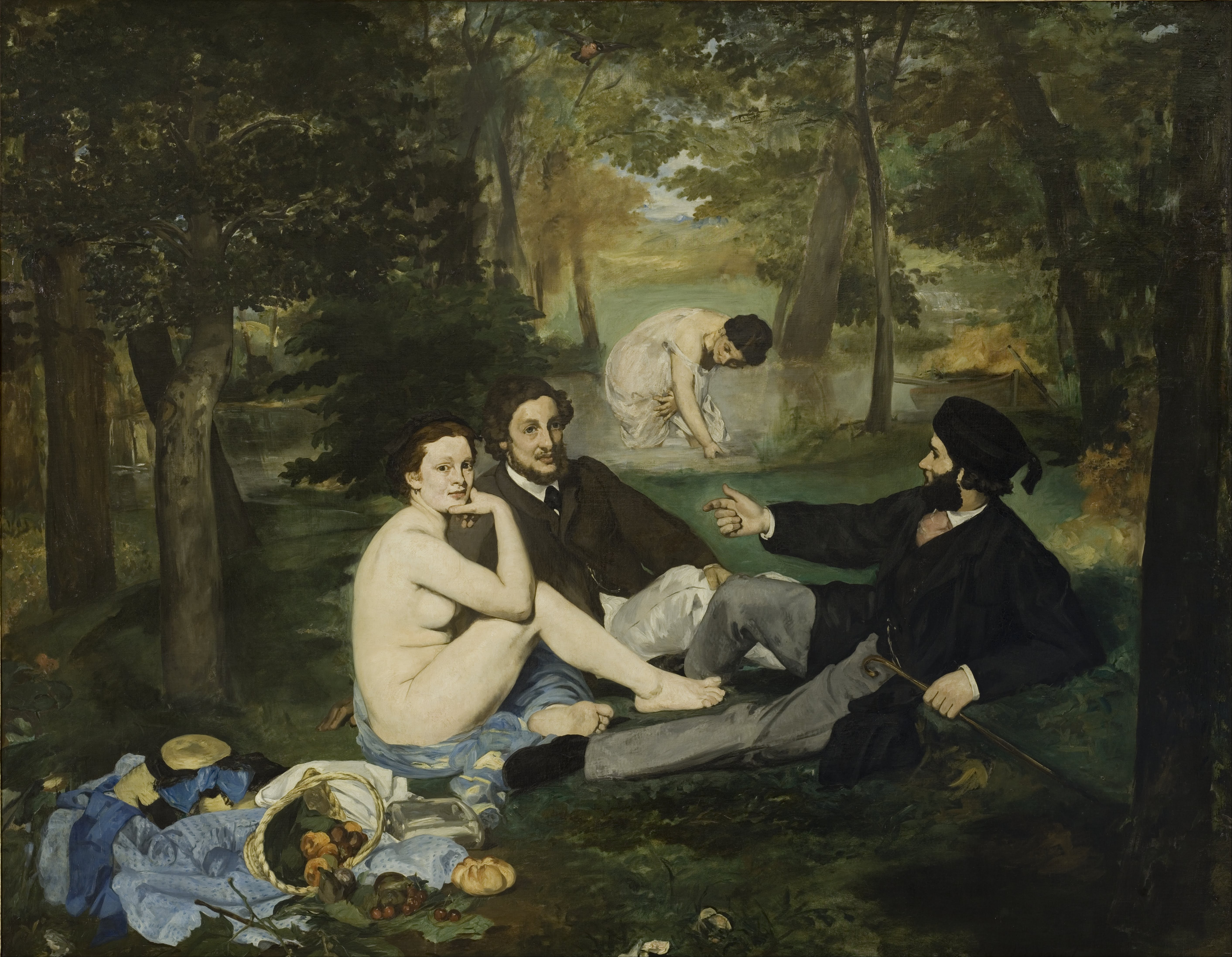
Musée d'Orsay, Paris, France
Two years later, Olympia provoked even greater outrage: a nude courtesan, clearly not a mythological goddess, meeting the viewer's gaze with unsettling directness.

Musée d'Orsay, Paris, France
Critics called his work ugly, crude, unfinished. But younger artists recognized something revolutionary: Manet was painting modern life without the veil of history or mythology.
When Fantin-Latour introduced them, Morisot recorded her ambivalence in her diary: "I am attracted and repelled by him. I think he has enormous talent, but his personality frightens me." What frightened her? Perhaps his confidence, his willingness to court scandal, or simply the intensity of his artistic vision. Whatever the reason, she agreed to sit for him.
1868–1869: The Balcony
Summer 1868. Manet began painting The Balcony, a large canvas inspired by Goya's Majas on a Balcony. Morisot sits in the foreground, dressed in white, holding a closed fan. Behind her stand two other figures: the violinist Fanny Claus and the painter Antoine Guillemet. But despite their presence, Morisot dominates. Her dark eyes stare out at us—not inviting, not flirting, simply staring with an intensity that makes the viewer uncomfortable.

Musée d'Orsay, Paris, France
The sittings were long and, for Morisot, frustrating. In letters to her sister Edma, she complained: "Manet lectures me constantly." But she also recognized something important happening. Unlike other male artists who painted women as objects of beauty or desire, Manet seemed interested in capturing her interiority—the fact that she thought, observed, judged.
When The Balcony appeared at the 1869 Salon, critics were baffled. Paul Mantz wrote: "What are they doing on this balcony? These figures seem to be there by chance." But what seemed like a failure of narrative was actually Manet's innovation: modern life doesn't have clear stories or moral lessons. People exist in moments without obvious meaning. This was radical.
THEMATIC DEEP DIVE: Portraiture and Female Subjectivity
Between 1868 and 1874, Manet painted Morisot eleven times—more than any other sitter in his career, including his wife Suzanne. These portraits raise complex questions about the relationship between artist and subject, particularly when the subject is herself an artist.
Traditional art history called Morisot Manet's "muse"—a term that implies passivity, inspiration, beauty, but not agency. More recent scholarship, particularly Anne Higonnet's groundbreaking 1990 biography, reframes these portraits as collaborative acts. Morisot chose to model for Manet as part of their artistic exchange. She was not a professional model but a colleague participating in his work while developing her own.
The portraits themselves resist conventional readings. In most, Morisot is dressed in black (mourning clothes after her father's death in 1874), her expression serious, her gaze direct or averted—never seductive, never merely decorative. In Repose (Portrait of Berthe Morisot) (1870), she reclines on a sofa, but the pose is intellectual rather than sexual. She looks exhausted, thoughtful, present.

Rhode Island School of Design Museum, Providence, USA
Compare this to Manet's Olympia (1863), where the nude courtesan reclines provocatively. The difference is stark: Olympia performs for the male gaze; Morisot simply exists, lost in her own thoughts.
What did Manet see when he painted her? Perhaps a kindred spirit—someone equally committed to modern art, equally willing to take risks. What did she gain from sitting for him? Possibly validation: being painted by the most controversial artist in Paris was a statement that she mattered, that she was part of the avant-garde, not just an "amateur lady painter."
1869–1870: Morisot's Early Work
While sitting for Manet, Morisot continued developing her own practice. In the summer of 1869, she painted The Harbor at Lorient, showing her sister Edma on a terrace overlooking the Brittany coast. The painting demonstrates her already-sophisticated understanding of light and atmosphere—the harbor recedes into silvery distance, the figures are sketched rather than highly finished, and the overall effect is one of immediacy.

National Gallery of Art, Washington, D.C., USA
This is important: when Morisot met Manet, she was not a beginner. She had already found her subjects (modern bourgeois life, landscapes, women in interior and exterior spaces) and was developing a distinctive technique characterized by rapid, visible brushwork.
Manet visited her studio and saw her work. According to family correspondence, he offered advice—but also praise. He recognized her talent. And perhaps he also recognized something he hadn't fully developed in his own work: the ability to paint intimate, domestic scenes with the same seriousness he brought to urban spectacle.
1870: War Interrupts Everything
July 19, 1870. France declared war on Prussia. What began as a conflict over Spanish succession spiraled into catastrophe. Within months, the Prussian army was advancing on Paris.
September 1870. The Siege of Paris began. For four months, the city was cut off from the outside world. Food became scarce. Parisians ate horses, rats, and animals from the zoo. The winter was brutal, and thousands died of cold and starvation.
Manet during the Siege: At 38, Manet was too old for active combat but joined the National Guard, serving as a gunner in the artillery. He sent his family (wife Suzanne and his two sons by Suzanne, though Manet maintained the fiction that they were her brothers) to safety in the southwest. His letters from this period reveal a man trying to maintain morale while witnessing horror. "Paris is gloomy," he wrote. "We eat dog, cat, rat... I won't tell you what the meat on sale really is." He sketched scenes of the siege but did little serious painting.
Morisot during the Siege: She remained in Paris with her parents, refusing to flee despite the danger. In letters to her sister Edma (who had married and moved to Brittany), Morisot described the grinding monotony and fear: "Everything is closed. We can't go out. I try to paint but have no heart for it." She worried about Manet, about their friends, about whether Paris—and French art—would survive. Her mother fell ill from the cold and privation. Painting seemed frivolous when survival was uncertain.
March–May 1871: The Paris Commune. After the French government surrendered to Prussia, radical Parisians seized control of the city, establishing a revolutionary Commune. For two months, Paris was essentially an independent socialist city-state. Then the French army retook the city in a week of street fighting so violent that as many as 20,000 Parisians died—executed, killed in combat, or caught in crossfire.
Manet and Morisot survived, but the Commune left deep scars on French society. The question of who had been right—the Communards or the government—divided families and friendships for decades. Neither Manet nor morisot was particularly political, but both were shaken by the violence and destruction. When they returned to painting in late 1871, the world seemed changed. The old certainties of the Second Empire were gone. A new, anxious, modern France was being born.
PART II: PARALLEL PATHS (1871–1874)
1871–1872: Return to Art
Late 1871. Paris slowly rebuilt. The burned Tuileries Palace stood as a charred ruin (it would eventually be demolished). But artists returned to their studios, and the cafés where they argued about art—the Café Guerbois, the Café de la Nouvelle-Athènes—reopened.
Manet resumed painting large-scale works intended for the Salon. His The Railway (1872–1873) shows a woman and child near the Gare Saint-Lazare, steam billowing in the background. The subject is aggressively modern: industrialization, urban life, transience. But critics remained hostile, calling the work unfinished and incomprehensible.

National Gallery of Art, Washington, D.C., USA
Morisot, meanwhile, created what many consider her masterpiece: The Cradle (1872). The painting shows her sister Edma gazing at her sleeping infant daughter. Edma's expression is tender but also ambivalent—there's love but also weariness, perhaps even a hint of melancholy. The gauze curtain around the cradle is rendered with extraordinarily rapid brushwork, almost dissolving into pure paint. The painting is intimate, psychologically complex, and technically radical.

Musée d'Orsay, Paris, France
The Cradle reveals Morisot's mature style fully formed: rapid execution, visible brushstrokes, and a subject—motherhood—that traditional art history dismissed as "minor" but which Morisot treats with the seriousness usually reserved for history painting or grand portraits.
1872: Manet Paints Morisot in Mourning
January 1872. Morisot's father died. She entered the required period of mourning, dressing entirely in black for a year. Manet painted her twice during this period: Berthe Morisot with a Bouquet of Violets and Berthe Morisot with a Fan. In both, she wears black, her expression somber. The violets in the first portrait are traditionally associated with modesty and faithfulness—but also with mourning.

Musée d'Orsay, Paris, France

Palais des Beaux-Arts de Lille, France
These are among the most psychologically penetrating portraits Manet ever painted. Morisot's grief is palpable but so is her strength. She looks directly at us (in Violets) or off to the side (in Fan), but in both she maintains dignity and composure. These are not portraits of a beautiful woman but of a complicated human being experiencing loss.
THEMATIC DEEP DIVE: The Impressionist Break
By 1873, a group of artists—Claude Monet, Pierre-Auguste Renoir, Camille Pissarro, Edgar Degas, Alfred Sisley, and Berthe Morisot—were increasingly frustrated with the Salon system. The Salon, controlled by the conservative Academy, rejected or hung in obscure locations any work that challenged traditional aesthetics. Monet's radical experiments with light, Renoir's free brushwork, and Degas's unconventional compositions were routinely dismissed.
In December 1873, they made a radical decision: they would organize their own exhibition, bypassing the Salon entirely. They formed a collective called the "Anonymous Society of Painters, Sculptors, and Engravers" (deliberately avoiding a manifesto or clear aesthetic program). They would exhibit together, sell works directly to the public, and create their own critical discourse.
Manet was invited but declined. Why? Pride, perhaps. Or strategic calculation. He believed the Salon, despite its conservatism, was where reputations were made. He wanted to change the institution from within, not abandon it. This decision would separate his path from Morisot's for the next decade.
Morisot, by contrast, committed fully to the Impressionist project. When the first Impressionist exhibition opened in April 1874 in photographer Nadar's studio on the Boulevard des Capucines, she exhibited nine works, including The Cradle and Hide and Seek. She was the only woman in the core group (Mary Cassatt would join later).
The exhibition was a critical disaster. Journalist Louis Leroy, writing in Le Charivari, mocked the artists, coining the term "Impressionists" (from Monet's Impression, Sunrise) as an insult: these were not finished paintings but mere "impressions," sketches. But younger collectors and critics recognized something important happening. Slowly, the Impressionists began building an audience outside the official channels.
December 22, 1874: Morisot Marries Eugène Manet
Late 1874. Berthe Morisot married Eugène Manet, Édouard's younger brother. Eugène was not an artist but an educated, financially comfortable man who loved art and admired his brother. The marriage was, by all accounts, based on mutual affection and shared interests.
For Morisot, the marriage was transformative. Unlike many women artists whose careers ended with marriage (her sister Edma stopped painting after her wedding), Morisot continued—and intensified—her artistic production. Eugène managed the household, supported her career, modeled for her paintings, and never questioned her right to work. In effect, she had what male artists took for granted: a supportive spouse who freed her from domestic burdens.
Édouard Manet attended the wedding and gave his blessing. The marriage created a complex family dynamic: Berthe was now Édouard's sister-in-law, which deepened their connection while also changing it. After 1874, he painted her less frequently—only one or two more portraits. It was as if the marriage shifted their relationship from the intensity of artist-model to something more familial and, in some ways, more equal.
THEMATIC DEEP DIVE: Gender and Marriage in the Art World
Morisot's ability to continue painting after marriage was exceptional. Most women artists of her generation faced a stark choice: art or family. The social expectation was that married women devoted themselves entirely to home and children. Painting was acceptable as a genteel hobby for unmarried middle-class women, but professional ambition was unseemly, even scandalous.
Consider Morisot's sister Edma. She showed early promise, studied with Corot alongside Berthe, and exhibited at the Salon. But when she married a naval officer in 1869, she stopped painting. Her letters to Berthe are heartbreaking: "I miss painting desperately, but it's impossible now. The children need me, and [my husband] doesn't understand why I would want to work." Edma lived vicariously through Berthe's career, urging her younger sister never to abandon art: "Promise me you'll never stop painting. One of us must continue."
Eugène Manet was unusual—perhaps even radical—in supporting his wife's career. He had no artistic ambitions of his own, which may have helped. There was no competition, no wounded pride when critics praised Berthe's work. He accompanied her to exhibitions, helped hang her paintings, and provided emotional support when critics were cruel (which they often were—gendered criticism was routine: "charming," "delicate," "feminine," code words for "minor").
After Berthe and Eugène's daughter Julie was born in 1878, Eugène became the primary caregiver while Berthe painted. This arrangement shocked their social circle but worked for them. In many ways, Eugène functioned as what we might now call a "stay-at-home father," though no such term existed then.
PART III: THE IMPRESSIONIST YEARS (1875–1879)
1875–1876: Morisot's Rapid Development
Morisot exhibited in the second Impressionist exhibition (1876), showing 18 works—more than anyone else. Critics noticed. Some praised her talent grudgingly ("for a woman"); others dismissed her as an amateur. But collectors began buying her work. Her paintings sold for prices comparable to Sisley and Pissarro, if somewhat lower than Monet and Renoir.
During these years, Morisot developed her mature style:
- Rapid brushwork: Visible, gestural, refusing to "finish" in the traditional sense
- Pale palette: Whites, light blues, pinks, soft greens—the colors of domestic interiors and suburban gardens
- Intimate subjects: Women reading, women at their toilette, children playing, family life
- Plein-air technique: Painting directly from nature, often in her garden at Bougival
Key works from this period:
- Woman at Her Toilette (1875–1880): A woman in a white robe, seen from behind, brushing her hair. The paint is almost sculptural in its thickness, applied rapidly with visible strokes.

Art Institute of Chicago, USA
- The Psyche Mirror (1876): Another toilette scene, showing a woman adjusting her dress before a standing mirror. The reflection is suggested rather than precisely rendered—a choice that anticipates Manet's famous mirror in A Bar at the Folies-Bergère.

Museo Nacional Thyssen-Bornemisza, Madrid, Spain
1876–1879: Manet's Salon Struggles
While Morisot committed to the Impressionist exhibitions, Manet continued submitting to the Salon—with mixed results. His Nana (1877), showing a courtesan in her dressing room being watched by an older gentleman, was rejected as too scandalous. (The painting's subject was drawn from Émile Zola's novel L'Assommoir, and everyone recognized the prostitute theme.)

Hamburger Kunsthalle, Hamburg, Germany
Manet exhibited Nana in a shop window on the Boulevard des Capucines (ironically, near where the Impressionists had held their first show). Crowds gathered to gawk and gossip. But the Salon rejection stung. Despite his revolutionary reputation, Manet craved official recognition—the medals, the praise, the validation that came from Salon success.
Other works from this period:
- The Monet Family in Their Garden at Argenteuil (1874): Manet visited Monet's suburban home and painted en plein air—unusual for him. The painting shows Monet's wife Camille and their son Jean. The brushwork is looser than his earlier studio work, suggesting Manet was experimenting with Impressionist techniques.

Metropolitan Museum of Art, New York, USA
- Boating (1874): A man and woman in a sailboat. The blue water and bright light show Manet absorbing lessons from Monet—and, possibly, Morisot.

Metropolitan Museum of Art, New York, USA
1878: Morisot and Motherhood
November 14, 1878. Berthe Morisot gave birth to her only child, Julie. The pregnancy and recovery kept her from exhibiting in the 1879 Impressionist show—the only one of the eight exhibitions she would miss.
Motherhood changed her subject matter. Julie became a frequent subject: as an infant, a toddler, a child. But Morisot's paintings of motherhood are never sentimental. She shows the reality: the exhaustion, the tenderness, the way children exist in their own worlds, only partially accessible to adults.
Example: Eugène Manet and His Daughter at Bougival (1881) shows her husband and daughter in the garden. Julie, about three years old, looks away from her father, absorbed in something beyond the frame. Eugène gazes at her with affection but also a kind of wistfulness—the parent's knowledge that the child is already becoming separate, unknowable.
PART IV: THE GREAT EXCHANGE (1880–1883)
1880: Manet's Health Declines
Early 1880. Manet began experiencing severe pain in his left leg—sharp, stabbing pains that made walking difficult. He also suffered from episodes of extreme fatigue and, occasionally, disturbed vision. His doctors diagnosed locomotor ataxia, a progressive degeneration of the nervous system. The cause, though never explicitly stated in polite society, was tertiary syphilis.
Syphilis was epidemic in nineteenth-century France, particularly among the urban middle and upper classes. It was contracted through sexual contact (often from prostitutes) and, before antibiotics, was incurable. The disease had three stages: primary (a painless sore), secondary (rashes, fever), and tertiary (which could appear decades later and affected the heart, brain, and nervous system). Tertiary syphilis caused dementia, paralysis, blindness, and excruciating pain.
Manet almost certainly contracted syphilis in his youth, probably in his twenties or thirties. The disease lay dormant for years, allowing him to work at full capacity through his forties. But by age 48, the symptoms were undeniable. He tried hydrotherapy (cold water treatments at spas), which provided temporary relief but no cure. He consulted multiple doctors, all of whom told him there was nothing to be done but manage the pain with morphine and other opiates.
THEMATIC DEEP DIVE: Illness and Artistic Production
How did Manet's declining health affect his art? This question has generated considerable scholarly debate.
The "Decline" Narrative (Traditional View):
Older art historians sometimes characterized Manet's late work as a falling-off—smaller paintings, less ambitious subjects, simpler compositions. This view implied that illness weakened his artistic powers.
The "Adaptation" Narrative (Contemporary View):
More recent scholars argue that Manet adapted brilliantly to his limitations. Unable to stand at an easel for hours, he painted smaller works but with no loss of quality. Unable to work on large salon machines, he focused on intimacy. And crucially, he began painting subjects he had previously avoided: gardens, flowers, domestic interiors—the territory Morisot had been exploring for a decade.
Consider the facts:
- Between 1880 and 1883, Manet painted some of his most beautiful and innovative works
- Spring (Jeanne Demarsy) (1881) is luminous, accomplished, fully realized
- A Bar at the Folies-Bergère (1882), painted in the final year of his life, is now considered one of his masterpieces
- His palette lightened dramatically—compare Olympia (1863), with its dark tones and dramatic contrasts, to Spring (1881), all pale greens, soft pinks, and whites
The question becomes: Did Manet's illness force him to paint differently, or did his evolving artistic vision coincide with his illness? Both are probably true. But the key point is this: in his final years, Manet painted increasingly like Morisot.
1880–1881: Converging Styles
Summer 1881. Morisot painted Woman and Child in the Garden at Bougival in her suburban garden. The painting shows her daughter Julie and a nurse surrounded by flowers and foliage. The brushwork is extraordinarily rapid—individual strokes of white, green, pink laid side by side, blending optically rather than on the palette. The figures almost dissolve into the vegetation, creating a sense of dappled light and summer heat.

Private collection
Same summer, 1881. Manet painted Spring (Jeanne Demarsy), showing a young actress in a flowered garden. Like Morisot's painting, the palette is pale (greens, whites, pinks), the brushwork is broken and rapid, and the figure is surrounded by flowers. Place the two paintings side by side, and the similarities are striking: same subject (woman in garden), same technique (impressionist brushwork), same mood (light, luminous, ephemeral).

J. Paul Getty Museum, Los Angeles, USA
Other comparisons from this period:
Interior/Domestic Spaces:
- Morisot, The Psyche Mirror (1876): Woman at her toilette, private moment
- Manet, Before the Mirror (1876): Nearly identical subject and composition

Solomon R. Guggenheim Museum, New York, USA
Conservatories/Indoor Gardens:
- Morisot, multiple paintings of women in conservatories (mid-1870s)
- Manet, In the Conservatory (1879): Bourgeois couple in a greenhouse—intimate, domestic, a subject Manet would not have touched in the 1860s

Alte Nationalgalerie, Berlin, Germany
Rapid Brushwork:
- Morisot's technique throughout the 1870s: visible, gestural, "unfinished"
- Manet's technique by 1880: increasingly similar, abandoning the highly finished surfaces of his earlier salon paintings

Musée Marmottan Monet, Paris, France
THEMATIC DEEP DIVE: Who Influenced Whom?
This is the central scholarly debate. The traditional answer: Manet influenced Morisot. The revisionist answer: the influence flowed both directions, and in the late period, primarily from Morisot to Manet.
Evidence for Manet influencing Morisot (1868–1874):
- She began painting more boldly after meeting him
- She adopted his interest in modern, urban subjects
- His confidence in pursuing a revolutionary path may have emboldened her
Evidence for Morisot influencing Manet (1875–1883):
- Timeline: Morisot's impressionist technique fully developed by 1872; Manet doesn't consistently paint this way until late 1870s
- Subject matter: Domestic life, gardens, bourgeois leisure—Morisot's territory—appear in Manet's work increasingly after 1875
- Palette: Morisot's pale colors (whites, pinks, pale blues) appear in late Manet
- Brushwork: Visible, gestural, rapid—Morisot's signature—becomes Manet's late style
- Specific comparisons: Multiple paintings where Manet seems to be working through problems Morisot already solved
Why did Manet borrow from Morisot?
Possible reasons:
- Illness: Smaller, quicker paintings suited his reduced stamina
- Artistic evolution: After twenty years of provocation and scandal, perhaps he wanted to explore intimacy
- Market: Garden scenes and domestic subjects sold well to bourgeois collectors
- Genuine admiration: He respected her work and learned from it
Most scholars now accept that the influence was reciprocal, with Morisot's impact on late Manet being significant and underappreciated until recently.
1882: A Bar at the Folies-Bergère
Spring 1882. Despite his declining health, Manet completed his largest and most ambitious late work: A Bar at the Folies-Bergère. The painting shows a barmaid named Suzon standing behind a marble bar stocked with bottles and a bowl of oranges. Behind her, a mirror reflects the crowded music hall. In the reflection, we see Suzon from behind, leaning forward to serve a top-hatted gentleman—but the spatial relationships are impossible. The reflection doesn't match the frontal view.
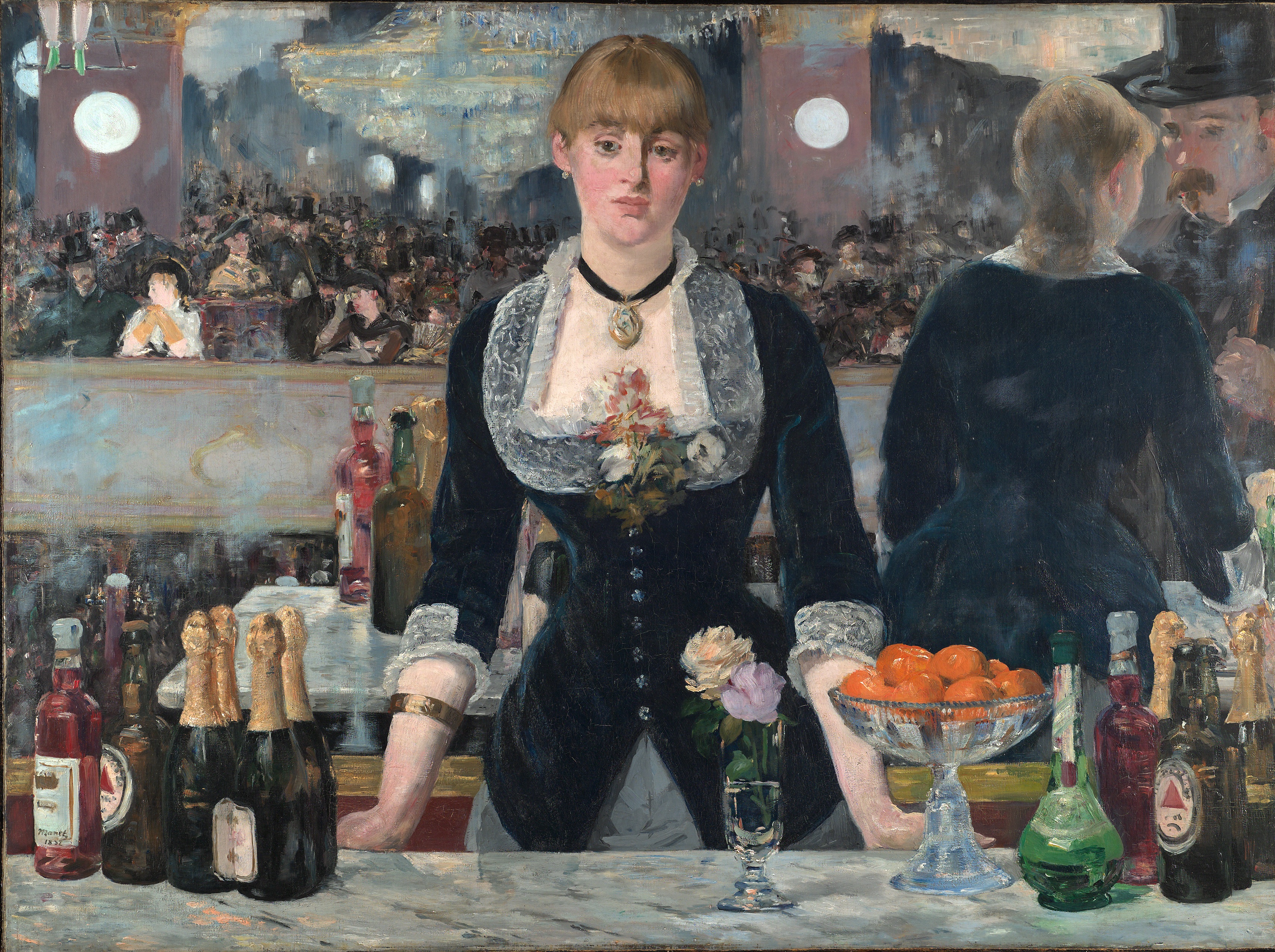
Courtauld Gallery, London, UK
This painting synthesizes everything Manet had learned:
- Modern subject: Urban entertainment, commerce, the new Paris of pleasure
- Psychological complexity: Suzon's expression is blank, tired, distant—she's there but not present, a worker performing service with her body while her mind is elsewhere
- Technical virtuosity: The bottles and fruit are painted with astonishing skill; the reflection is deliberately ambiguous
- Impressionist technique: The brushwork is looser than Manet's early work, the crowd in the background dissolved into blurred faces and colors
The painting appeared at the 1882 Salon and received mixed reviews. Some praised it as a masterpiece; others found it confusing and incomprehensible. But it secured Manet a second-class medal, which meant his future submissions would automatically be accepted without jury review. He had finally achieved the official recognition he'd craved his entire career.
1883: Manet's Final Months
Winter 1882–1883. Manet's condition deteriorated rapidly. The pain in his leg became unbearable. Gangrene set in—a common complication of tertiary syphilis, caused by damaged blood vessels. In April 1883, his leg was amputated in a desperate attempt to save his life.
The operation failed. On April 30, 1883, Édouard Manet died at age 51. He was buried in Passy Cemetery in Paris. His funeral was attended by hundreds: artists, critics, collectors, friends. Monet, Renoir, Pissarro, Degas—all the Impressionists he had influenced but never officially joined—served as pallbearers.
Berthe Morisot was devastated. She recorded in her diary: "How sad I feel today." A year later, attending a posthumous Manet exhibition, she wrote: "Saw the exhibition of Manet's works. In the first room, all his portraits of me. I cried."
PART V: AFTER MANET (1883–1895)
1883–1890: Morisot Continues
Manet's death marked the end of an era, but Morisot's career continued. She exhibited in the Impressionist shows of 1886 (the eighth and final group exhibition), by which time the movement was fracturing. Seurat and Signac introduced pointillism; Cézanne was moving toward something more structured; Degas remained devoted to drawing.
Morisot, now in her forties, remained committed to painting from life—gardens, interiors, her daughter Julie growing up. Her late work shows increasing confidence and looseness. She was no longer proving herself but simply working.
Key late works:
- The Cherry Tree (1891–1892): Julie picking cherries, dappled light through leaves

Musée Marmottan Monet, Paris, France
- Young Girl with a Greyhound (1893): Julie, now a teenager, with the family dog

Musée d'Orsay, Paris, France
- Julie Manet and Her Greyhound Laertes (1893): Another portrait of Julie, showing her evolving from child to young woman

Musée Marmottan Monet, Paris, France
1892–1894: Recognition and Melancholy
Morisot's first solo exhibition opened at Galerie Boussod & Valadon in 1892. Critics praised her "feminine sensibility" (still coded language) but also acknowledged her technical mastery and her importance to Impressionism. She sold well. Major collectors—Americans, especially—bought her work.
But she also experienced periods of depression and doubt. Eugène's health was failing (he would die in 1892), and she worried about Julie's future. She wrote to Mallarmé, the poet who had become a close friend: "I wonder if all this work matters. Will anyone remember us?" Mallarmé reassured her: "Your paintings will outlive us all."
1895: Morisot's Death
February 1895. Morisot caught influenza while nursing Julie through pneumonia. Her immune system, weakened by decades of work and stress, couldn't fight the infection. She developed pneumonia herself and, on March 2, 1895, died at age 54.
Her funeral was small, attended by family and close friends: Degas, Monet, Renoir, Mallarmé. Sixteen-year-old Julie was now an orphan. In his eulogy, Mallarmé said: "She painted as birds sing, with a naturalness that was also profound art."
After her death, Monet and Degas organized a posthumous exhibition of her work (1896). All 394 paintings shown sold. But despite this commercial success, Morisot began to fade from art historical memory. Textbooks mentioned her briefly, if at all. She was "Manet's sister-in-law" or "the woman Impressionist"—footnotes to the male story.
PART VI: THE RELATIONSHIP EXAMINED
Through a Contemporary Gender Lens
From a 21st-century perspective, the Manet-Morisot relationship raises complex questions about power, gender, and artistic exchange in a patriarchal society.
The Power Imbalance:
When they met in 1868, Manet held every advantage:
- He was male (automatic social and professional authority)
- He was older (36 vs. 27)
- He was famous (or infamous)
- He had access to spaces and subjects denied to women (brothels, cabarets, outdoor cafés)
- He could exhibit without being dismissed as an "amateur"
Morisot operated under severe constraints:
- Women artists were assumed to be hobbyists, not professionals
- She couldn't attend the École des Beaux-Arts or study from nude models
- She couldn't move freely through urban spaces without a chaperone
- Her subjects were limited to what "respectable" women could access
- Critics used gendered language that diminished her work
And yet:
- Morisot exhibited at the Salon before meeting Manet
- She committed to the Impressionist project when Manet did not
- She exhibited more consistently than most of the male Impressionists
- Her technique was, by most measures, more radically "impressionist" than Manet's
- She sold work and supported herself (before marriage) and continued her career after marriage
The Question: Was Morisot Manet's equal despite the patriarchal constraints, or are we projecting modern values onto a historical situation where equality was impossible?
Scholarly consensus: She was constrained by gender but operated with as much agency as the system allowed. She made strategic choices: allying with the Impressionists (a risk), continuing to paint after marriage (unusual), and developing a distinctive vision within the subjects available to her.
The portraits raise the most difficult questions. Was Manet objectifying her? The paintings themselves suggest not—she is never sexualized, never reduced to beauty alone. She retains psychological complexity and subjectivity. But the fact remains: he painted her eleven times; she never painted him. The asymmetry reflects the gender dynamics of the era.
How Their Peers Viewed the Relationship
Contemporary accounts are scarce but suggestive:
Edgar Degas (fellow Impressionist, notoriously prickly): Respected both artists but commented that Manet "paints Mlle. Morisot too often." Whether this was jealousy or disapproval of potential romantic implications is unclear.
Stéphane Mallarmé (poet, close friend of both): Treated them as artistic equals. In letters, he discussed their work with the same seriousness and never suggested Morisot was Manet's inferior.
Émile Zola (novelist, Manet's defender): Mentioned Morisot in passing as a "talented student" of Manet—revealing the automatic hierarchical assumption even among progressives.
Mainstream critics: Often speculated about the relationship with barely veiled sexual innuendo. A woman sitting for a male artist was assumed to be sexually available (the artist-model relationship was often synonymous with mistress). That Morisot was respectable and middle-class made the arrangement somewhat scandalous.
After the marriage to Eugène (1874):
The marriage "legitimized" their closeness. As relatives, they could spend time together without gossip. But it also changed the dynamic. Édouard's painting of Berthe stopped (mostly), suggesting that the intense artist-model relationship had run its course.
How Society Viewed Women Artists
The "Lady Amateur" Paradigm:
Middle-class women were encouraged to paint as a genteel accomplishment, like playing piano or speaking French. But professional ambition was suspect. The logic: real art required genius, genius was masculine, therefore women could produce charming works but not great art.
The "Separate Spheres" Ideology:
Women belonged to the domestic sphere (home, children, private life); men to the public sphere (work, politics, culture). A woman exhibiting art was crossing into the public sphere, which threatened the gender order.
Morisot's Strategy:
She painted domestic subjects, which seemed to confirm her "feminine" nature, but treated them with the seriousness and technical ambition of "masculine" art. In doing so, she both conformed to and subverted gender expectations.
The Criticism:
Reviews of Morisot's work are studies in gendered language:
- "Charming" (not "powerful")
- "Delicate" (not "bold")
- "Feminine sensibility" (not "universal vision")
- "Accomplished for a woman" (qualifier always present)
Compare this to reviews of Manet:
- "Brutal" (compliment, meaning strong)
- "Revolutionary" (male artists as heroes)
- "Uncompromising" (genius doesn't compromise)
Same technique (rapid brushwork), different language. For Manet, it was revolutionary; for Morisot, it was "unfinished" because she lacked the skill to complete her paintings.
CONCLUSION: A Partnership Reconsidered
For over a century, art history told the story of Impressionism as a story of male genius: Monet capturing light, Renoir painting pleasure, Manet breaking with tradition, Degas exploring movement. Women—Morisot, Mary Cassatt, Marie Bracquemond—appeared as footnotes, talented but secondary.
Beginning in the 1980s, feminist scholars began asking different questions: What if we take women artists as seriously as men? What if domestic subjects are as important as urban spectacle? What if technical innovations came from multiple sources, including women?
When viewed through this lens, Berthe Morisot emerges not as Édouard Manet's student or muse but as his colleague, perhaps even his teacher in certain crucial ways. The evidence is clear:
- Her impressionist technique was fully formed earlier than his
- Her subjects (gardens, domestic life, bourgeois leisure) became his subjects in his late period
- Her palette (light, luminous, pale) influenced his late palette
- Her rapid, visible brushwork became his late style
Does this diminish Manet? No. It makes him more interesting. It shows he was open to learning, even from someone society considered his inferior. It shows that artistic innovation is collaborative, not the work of isolated geniuses.
Does this finally give Morisot her due? Partially. She's been "rediscovered" by scholars, but she still hasn't fully entered the popular canon. Ask a random person to name an Impressionist, and they'll say Monet. Very few will say Morisot.
The Manet-Morisot relationship matters because it reveals how art history is made—not just by who paints what, but by who writes about it, who gets exhibited, who gets remembered. For too long, men wrote the history and centered male artists. Now, with more diverse voices writing art history, we're seeing a fuller, more complex, and ultimately more truthful picture.
Édouard Manet and Berthe Morisot: two artists, one revolution. Not master and student. Not genius and muse. But partners in the risky, collaborative work of creating something new.
Document prepared for: General readers interested in art history, gender studies, and 19th-century France
Total word count: ~13,500 words
Date: November 2025


No comments:
Post a Comment